
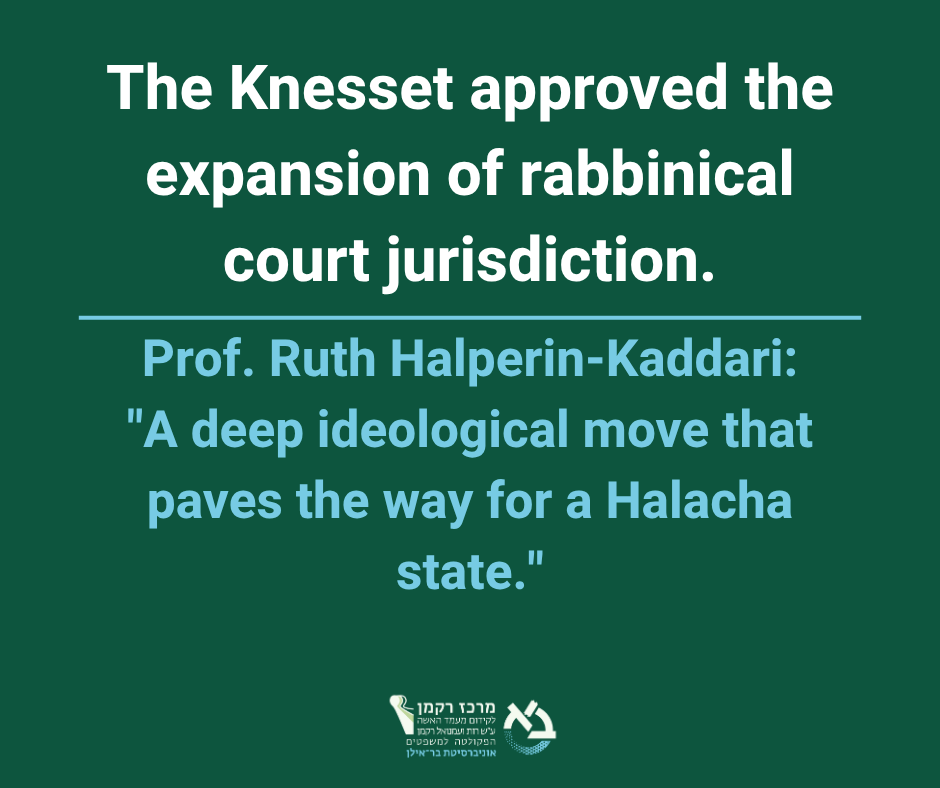
Last night (March 23rd, 2026), amid an ongoing war on multiple fronts, the Knesset voted and approved, in its second and third readings, the bill to expand the jurisdiction of rabbinical courts.
What it means:
Rabbinical courts will have the authority to adjudicate civil disputes — contracts, labor relations, property — according to Jewish religious law (Halacha). At the last moment, a particularly dangerous clause was inserted: the ruling will be immediately enforceable, with no need for judicial approval and no possibility of appeal.
Who will it harm?
Women, workers, and vulnerable populations. While it is officially framed as “consensual arbitration,” reality shows that those in positions of economic dependence will not always be able to refuse — “consent” under such circumstances is effectively coercion. It is also important to note that women do not serve as judges in rabbinical courts.
Why is it dangerous?
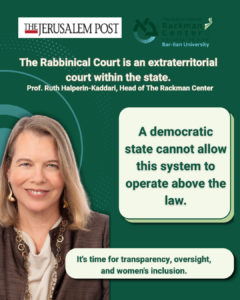
This creates a parallel judicial system — without transparency, without appeal, and without civilian oversight. A system that is not bound by the principles of equality and human rights.
Prof. Ruth Halperin-Kaddari, Head of the Rackman Center for the Advancement of Women’s Status, Faculty of Law, Bar-Ilan University: “This is a deeply ideological move that expands religious authority at the expense of civil rights, creates a parallel justice system, and harms primarily women, workers, and vulnerable populations — under the guise of ‘consent’ that is not truly free — and paves the way for a Halacha state.”